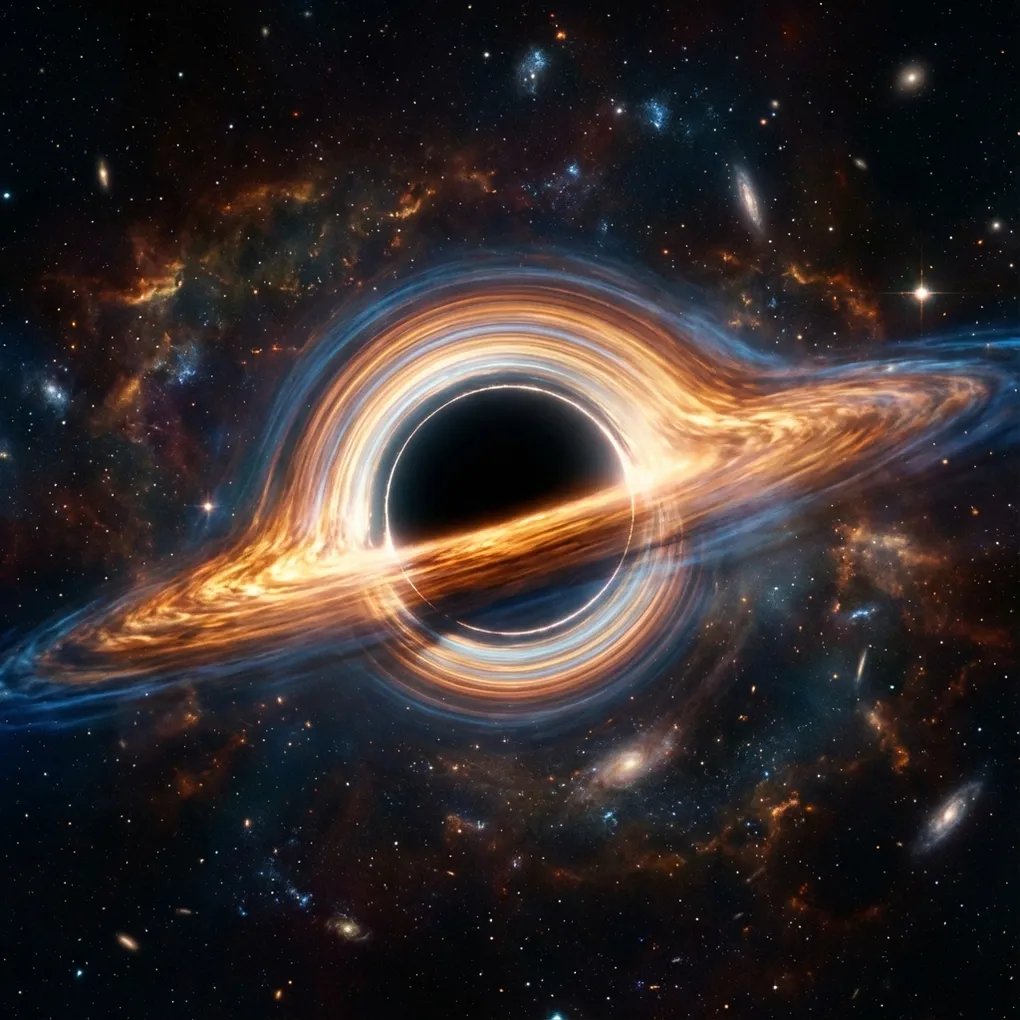
The Mystery of Black Holes: Understanding the Universe's Most Enigmatic Objects
Black holes are among the most fascinating and terrifying objects in the universe. They are regions of spacetime where gravity is so strong that nothing—no particles or even electromagnetic radiation such as light—can escape from it. These cosmic phenomena challenge our understanding of physics and continue to captivate scientists and space enthusiasts alike.
What Exactly is a Black Hole?
A black hole is a region in space where the gravitational pull is so intense that it warps the fabric of spacetime itself. The boundary surrounding a black hole is called the event horizon—the point of no return. Once anything crosses this threshold, it is inevitably pulled toward the singularity at the center, where all the mass is compressed into an infinitely small point.
The concept of black holes was first predicted by Albert Einstein’s theory of general relativity in 1915, though the term “black hole” wasn’t coined until 1967 by physicist John Wheeler.
How Do Black Holes Form?
Black holes form through several different processes:
Stellar Black Holes
Most black holes form from the remnants of massive stars. When a star with at least 20-25 times the mass of our Sun reaches the end of its life, it undergoes a catastrophic supernova explosion. If the remaining core is massive enough (typically more than 3 solar masses), it will collapse under its own gravity, forming a stellar black hole.
Smaller stars follow different paths: those with less mass become neutron stars or white dwarfs, but they lack the gravitational force necessary to create a black hole.
Supermassive Black Holes
At the centers of most galaxies, including our own Milky Way, lurk supermassive black holes with masses ranging from millions to billions of times that of our Sun. Scientists are still investigating how these giants formed, but theories suggest they may have grown from smaller black holes that merged and consumed vast amounts of matter over billions of years.
Intermediate and Primordial Black Holes
Intermediate-mass black holes (between 100 and 100,000 solar masses) and primordial black holes (theorized to have formed in the early universe) represent other categories, though they are less common and harder to detect.
The Event Horizon: Point of No Return
The event horizon is the defining feature of a black hole. It’s not a physical surface but rather a boundary in spacetime. The size of the event horizon is determined by the Schwarzschild radius, which depends on the black hole’s mass.
For a black hole with the mass of our Sun, the event horizon would have a radius of about 3 kilometers. For a supermassive black hole like the one at the center of our galaxy (Sagittarius A*), which has a mass of about 4 million solar masses, the event horizon extends to about 12 million kilometers.
How Do We Detect Black Holes?
Since black holes don’t emit light, detecting them requires indirect methods:
Observing Nearby Matter
When a black hole is part of a binary system with a normal star, it can pull matter from its companion. This matter forms an accretion disk that spirals into the black hole, heating up to millions of degrees and emitting intense X-rays that we can detect with space telescopes.
Gravitational Lensing
Black holes bend light from objects behind them, creating a gravitational lensing effect. This distortion can reveal the presence of a black hole even when it’s not actively consuming matter.
Gravitational Waves
In 2015, the LIGO observatory made history by detecting gravitational waves—ripples in spacetime caused by two black holes merging. This opened an entirely new way to study these mysterious objects.
Direct Imaging
In 2019, the Event Horizon Telescope collaboration released the first-ever image of a black hole’s shadow in the galaxy M87. This groundbreaking achievement confirmed decades of theoretical predictions and gave us our first visual evidence of these cosmic giants.
The Physics of Black Holes
Black holes represent extreme conditions where our understanding of physics is pushed to its limits:
Time Dilation
Near a black hole, time passes differently than it does far away. An observer falling toward a black hole would experience time normally, but to an outside observer, they would appear to slow down and freeze at the event horizon—a phenomenon called gravitational time dilation.
Spaghettification
The tidal forces near a black hole are so extreme that any object falling in would be stretched vertically and compressed horizontally in a process scientists call “spaghettification.” The difference in gravitational pull between the near and far sides of an object becomes so great that it would be torn apart.
Hawking Radiation
In 1974, Stephen Hawking theorized that black holes aren’t completely black. Due to quantum effects near the event horizon, they should emit a faint radiation, now called Hawking radiation. This means black holes can slowly evaporate over incredibly long timescales.
Black Holes and the Future of Astronomy
Black holes continue to be at the forefront of astronomical research. They help us understand:
- Galaxy formation and evolution: Supermassive black holes play a crucial role in shaping galaxies
- Fundamental physics: They provide natural laboratories for testing general relativity and quantum mechanics
- The nature of spacetime: Studying black holes helps us understand the fabric of the universe itself
“The black hole teaches us that space can be crumpled like a piece of paper into an infinitesimal dot, and that time can be extinguished like a blown-out candle.” — John Wheeler
Conclusion
Black holes represent one of the most extreme and fascinating phenomena in the universe. From their violent formation in stellar explosions to their role in shaping galaxies, these cosmic giants continue to challenge and expand our understanding of physics. As technology advances and new detection methods emerge, we can expect even more exciting discoveries about these mysterious objects in the years to come.
Whether you’re a seasoned astronomer or simply curious about the cosmos, black holes remind us of how much there is still to learn about our universe and our place within it.